I am sorry I have not posted anything for two days now. All is well here but we have been very busy. We ended our work an hour early on Thursday and then most everyone traveled on our big trip to the fantastic site called Petra. Then Friday we got up early (while a little later than our work schedule) 5AM. We ate breakfast and then visited Petra from about 6AM to 1pm, then we ate lunch and headed back to camp.

On our way south to the site of Petra, we stopped for an overview of the Crusader castle called Shobak. It is the earliest Crusader castle in Jordan, even older than Karak. It was built in 1115 by Baldwin I. The castle surrender in 1189, 2 years after the Crusaders were defeated at the battle of the Hattin. The Crusaders surrendered only after many had gone blind from starvation.
We stayed in a nice hotel with an overlook of the Petra area. They had a large swimming pool that several people enjoyed and then we had dinner at 8pm. We were up at 5AM, breakfast at 5:30AM and were in the site by about 6AM. We were able to use a pass given to us by the Department of Antiquities so we did not have to pay the 21 Jordanian Dinars to get in (about $37/person).

We were the first people to walk into the site. Arriving early in the morning has several advantages. You beat the crowds of tourists and you get to walk into the site with very little noise. Also you get to spend several hours at the site before it begins to get hot. On our walk to the gorge entrance to the site we passed the Obelisk tomb. Petra has many tombs that have been carved into the red Nubian sandstone.

The Nubian sandstone is soft enough to be carved easily and it has various shades and hues which add to its beauty. Here you can see a section with several bands of color.
 As we walked through the gorge or Siq, we saw channels which the Nabateans used to control water flow into the city. Here you can see the channel which they used and a portion of the Roman period road which ran through the Siq.
The Nabateans were masters of water collection, storage, and routing. In fact their techniques have been studied recently to help Jordan deal with its water problems. Here you can clearly see the a portion of the ceramic tile used to carry the water through the Siq.
 The Nabateans flourished from about 200BC to around AD 100, they derived their wealth from long distance trade of luxuary items (silks, spices, incense, etc.) and they operated as "middlemen" in the trade between the east (India and China) and the Mediterranean area. Eventually the Romans took control over the region in AD 106. The Nabateans were from Northern Arabian and used camel caravans to carry the goods. Above you see part of a carving that has partially worn away, which shows a camel caravan. You can see the the feet of a camel on the left with a person standing on the right.
Then we came to the most famous site of Petra. Here you can see the Treasury as viewed through the Siq with and camel seated in front. This is a site which inspires awe every time I have seen it.

We arrived early enough so their were no tourists or even vendors which makes the experience even better. The "Treasury" or al-Khazneh is quite popular with Hollywood, of course made most famous by Indiana Jones.
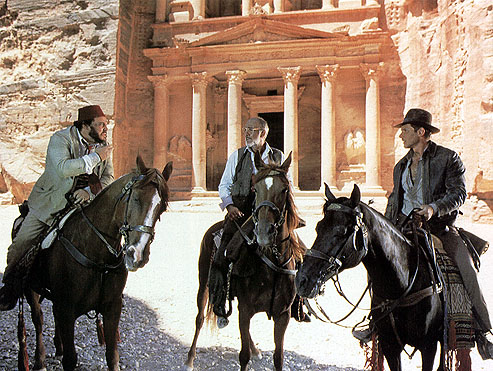 Here is Indy at Petra in the Last Crusade.
 Petra is also featured in the new Transformers movie.
 We did not see Indy or Transformers but we did see these camels waiting to give tourists ride around Petra.
 We walked further into the city and passed these camels with their colorful saddles.
 We later passed this unique Roman theater which is carved from the sandstone.
 We explored the ancient ruins by following the Roman road into the center of the city.
 This is a view of the Roman road with the remains of a Triumphal Entry.
 On the slope above the Roman is the Great Temple of Petra, which has been excavated by a team from Brown University.
 There is a nice museum inside the site with features items found at the site. Above is a nice example of the unique Nabatean pottery.
 Some of us climbed many steps up a trail to el Deir or the Monastery. Along the way are beautiful views like this one.
 Here you must walk between the cliff walls and this large block of standstone.
Here is the "Monastery" which looks like the "Treasury" but it is much large. Here Ralph Carnathan stands near the doorway.

Here you have another view. You might be able to see some tourists in the lower right hand corner of the photo.
 As Tim Snow and I headed back down we saw this donkey loaded with 2 tanks of propane, used by the small tourist shops to run their generators.
 We stopped to visit the large Byzantine church as we headed back towards the entrance. you can see the beautiful mosaics which represent the different seasons of the year.
One of the floor mosaics of the church featured an image of a camel, which seemed quite appropiate at Petra.
It getting late so I will end for now. Tomorrow we are back to our usually schedule with a wake up call at 3:45 AM.
 Here is donkey loaded with water bottles.
John Wineland
Karak, Jordan


